.png)
Gay Male Age-Gap Relationships:
Data, Dynamics, and How to Make Them Work
Gay male age-gap relationships are far more common, stable, and satisfying than cultural stereotypes suggest. When we set aside familiar narratives—the "sugar daddy" and "gold digger" tropes—the data tells a different story. Research shows these relationships are a normative feature of gay culture, not a deviation from it. The numbers point to resilience, adaptation, and high relationship satisfaction.
This article covers four data-backed findings about gay age-gap relationships:
-
Age gaps are statistically more common among gay male couples than any other group
-
Satisfaction and trust often exceed levels found in same-age relationships
-
Historical and cultural factors help explain why these patterns exist
-
Communication skills matter more than age similarity for long-term success
Understanding the reality behind these relationships can help couples move past judgment and focus on what actually works. LGBTQ+-affirming couples therapy supports partners in building the skills that research links to lasting connection.
The Quick Facts :
STATISTICS
Get informed on the statistics around same-sex age gap relationships.

SATISFACTION
Find out how relationship satisfaction compares in age-gap relationships.

RED FLAGS
Are These Age-Gap Red Flags Showing Up In Your Relationship?
What the Data Actually Says About Gay Male Age-Gap Relationships
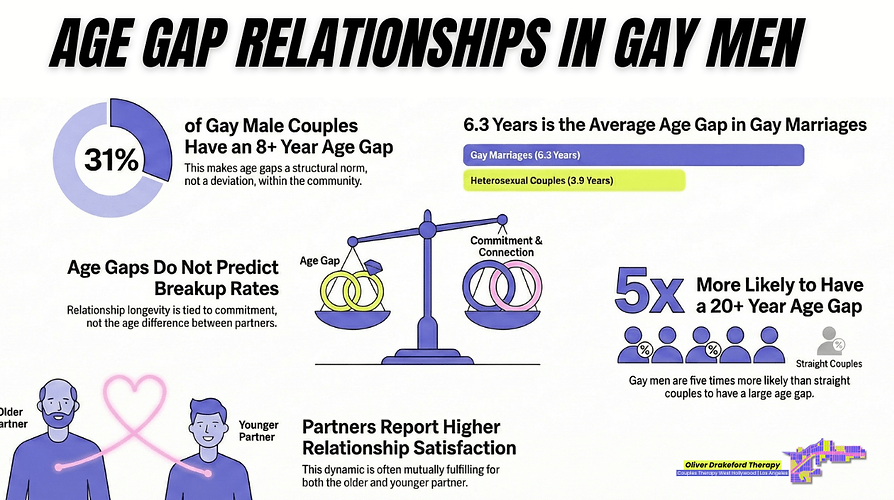
If you have ever worried that your relationship is an outlier, the numbers tell a very different story. In the gay male community, bridging a generational divide isn’t a deviation—it is a structural norm. As the statistics illustrate, intergenerational relationships are not only prevalent but are also statistically shown to be just as stable and satisfying as same-age partnerships.
-
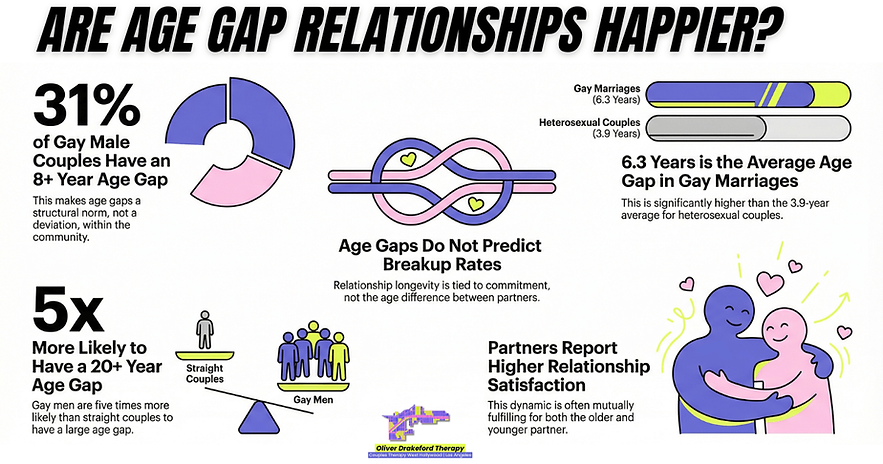
It's The Norm: With 31% of gay male couples having an age gap of 8 years or more, you are part of a substantial demographic. Nearly 1 in 3 gay couples.
-
Heteronormativity: Don't measure your relationship by heterosexual standards. Our community's average age gap (6.3 years) is nearly double that of straight couples, and gay men are 5x more likely to successfully navigate a 20+ year difference.
-
Stability is About Commitment: The fear that age gaps lead to breakups is unfounded. Research confirms that longevity is tied to emotional commitment and connection, not birth years. Conflict or distress comes likely comes from differences and not knowing how to navigate them ... which is what therapy is great for!
-
Happiness is High: Far from being "mismatched," partners in age-gap relationships frequently report higher relationship satisfaction, validating that these unions are often mutually fulfilling and deeply resilient (particularly if you happen to be the older partner!)
It's not the number of years between you that causes issues, it's what they mean. Take the mini-quiz here.

Gay Male Relationship Therapist: Oliver Drakeford LMFT, CGP
Find out more about the Four Pillars Of Relationship Success in our free LGBTQ+ Couples Intimacy Quiz


How Common Are Age Gaps in Gay Male Couples? (Stats and Research)
The single most impactful finding from the data is that age-gap relationships aren't a fringe occurrence in the gay male community; they are a statistical norm. What might feel like an outlier in the heterosexual world is a documented, common feature of gay relational patterns.
The statistics around age-discrepancy relationships are clear:
-
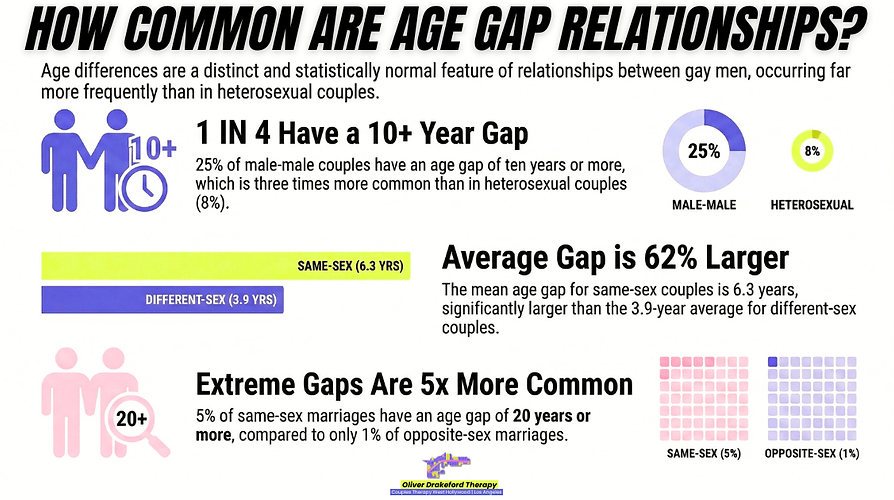
Approximately 25% of all male-male couples have an age gap of 10 years or more. This is nearly three times the rate for heterosexual couples, which sits at around 8%.
-
The mean (or average) age gap for same-sex couples is 6.3 years, a significant jump from the 3.9-year average for different-sex couples.
-
For relationships with very large age gaps of 20 years or more, the difference is even more stark. They are five times more common in same-sex marriages (5%) than in opposite-sex marriages (1%).
-
This trend not only exists but intensifies later in life. Data on remarried couples shows the mean age gap for same-sex couples climbs to 7.4 years, directly contradicting heteronormative patterns where age gaps often compress over time.
This data provides powerful validation, reframing these relationships from a perceived aberration that requires justification to a documented, statistically normal characteristic of the community
The age-gap isn't the enemy. How it's used is what matters. Take our free mini-quiz
Do Gay Age Gap Relationships Work And Are They Healthy?

Yes, gay age gap relationships work and can be just as healthy—or healthier—than same-age partnerships. Research challenges the assumption that larger age differences create instability.
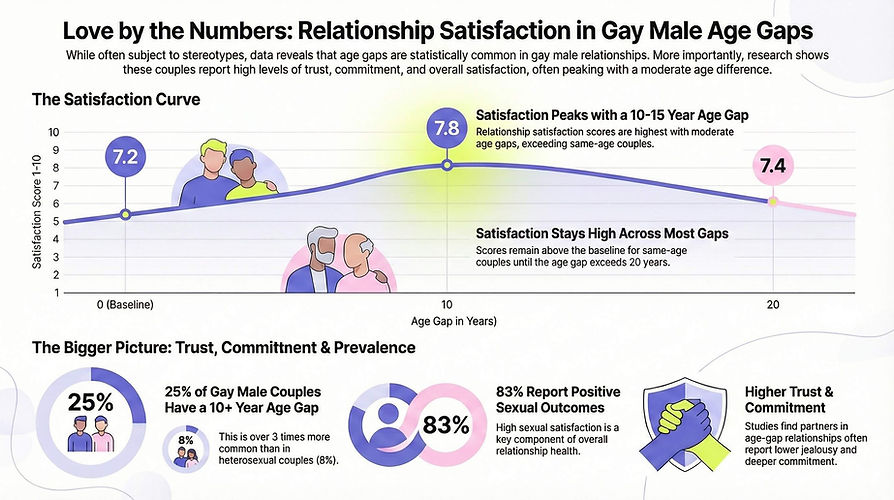
Studies show that satisfaction, trust, and commitment are often higher in age-gap relationships, not lower.
Couples with moderate age gaps (5-15 years) scored 7.8 out of 10 on relationship satisfaction, compared to 7.2 for age-matched couples.
"Emotional intimacy—the ability to talk about your feelings and tolerate the feelings of others—is a much stronger predictor of satisfaction than demographic factors like age," says Oliver Drakeford, LMFT, an LGBTQ+-affirmative couples therapist in West Hollywood.
Research highlights these patterns in age-gap relationships:
-
Higher reported levels of trust and commitment
-
Lower levels of jealousy compared to same-age couples
-
Satisfaction scores that meet or exceed similar-age relationship benchmarks
-
Success tied to communication skills, not age similarity
Every relationship has differences and imbalances that cause conflict. What matters is how partners navigate those differences together. LGBTQ+-affirming couples therapy can help partners build the communication skills that predict long-term success.
Find out more about the red-flag in age-gap relationships

How Big is Too Big Of An Age Gap In A Gay Relationship?
There's no universal rule for how big is too big of an age gap in a gay relationship—research shows age differences are simply more common among gay male couples than other groups.
The average age gap in same-sex couples is 6.3 to 6.5 years, compared to 3.9 years in heterosexual couples. This makes larger gaps a normal part of gay relationship culture, not an automatic red flag.
According to demographic research on U.S. same-sex marriages, approximately 25% of male-male couples have an age difference of 10 years or more, compared to just 8% of heterosexual couples.
Here's how age gaps compare across relationship types:
-
31% of gay male couples have an 8-year or larger age gap (vs. 13% of heterosexual couples)
-
25% of gay male couples have a 10-year or larger gap (vs. 8% heterosexual, 15% lesbian)
-
5% of same-sex marriages have a 20-year or larger gap (vs. 1% of opposite-sex marriages)
What matters most is whether both partners feel respected, equal, and fulfilled—not the number itself. Couples therapy in West Hollywood can help partners explore whether their relationship dynamics support mutual growth.
It's not the number of years between you that causes issues, it's what they mean. Take the mini-quiz here.
The Relationship Age Gap Red Flag: Power

The real age gap red flag isn't the age difference itself—it's how a difference in age can result in a difference in power.
Power exists in every relationship, someone is smarter, someone earns more, someone is more social and as much as we want to strive for 'equal' relationships, those differences make it technically impossible.
Healthy partnerships distinguish between "power to" (generative, collaborative) and "power over" (dominant, controlling).
Watch for these warning signs of unhealthy power dynamics:
-
One partner consistently makes major decisions without input
-
Financial resources are used to control behavior rather than support goals
-
One person's needs routinely override the other's
-
Disagreement or questioning is discouraged or punished
-
One partner feels helpless to act independently
-
Conversations about decisions get explosive
-
Emotional manipulation as a way to control or exert influence.
Reading a list of warning signs can feel abstract until you apply it to your own relationship. That's why we've created this quick self-assessment focused on Equilibrium—one of the four pillars of relationship success in the CARE framework.
These four questions explore how decisions get made, how responsibilities are divided, and whether expectations feel mutual. It's not a diagnostic tool, and a higher score doesn't mean your relationship is doomed—it simply highlights areas worth examining more closely. Think of it as a conversation starter, either with yourself or with your partner.
What's The Power In Your Relationship?
Find out more about the Four Pillars Of Relationship Success in our free LGBTQ+ Couples Intimacy Quiz
Weekly West Hollywood Relationship Email
I send out a weekly relationship email, and I'd love for you to be part of it.


Frequently Asked Questions About Gay Male Age-Gap Relationships
Are age-gap relationships common among gay men?
Yes. Research consistently shows that age-gap relationships are more common among gay male couples than among heterosexual couples. Studies estimate that roughly one-quarter of male–male couples have an age difference of 10 years or more, and larger gaps are not unusual. In other words, if you’re in an age-gap relationship, you’re far from alone.
Is it “normal” to be in a gay relationship with a big age difference?
It is absolutely normal. While age-matched relationships are often treated as the cultural default, gay male relationships have long followed more flexible patterns around age, roles, and timing. What matters far more than age is whether the relationship feels mutually respectful, emotionally safe, and chosen freely by both partners.
Do age-gap relationships work long term?
They can — and often do. Research suggests that moderate age gaps (roughly 5–15 years) are associated with similar or even slightly higher relationship satisfaction compared to age-matched couples. Long-term success depends less on age and more on factors like communication, shared values, and how couples navigate life-stage differences together.
Are age-gap relationships more likely to have power imbalances?
Not inherently. Power imbalances are about money, emotional dependence, decision-making, and boundaries, not age alone. Some age-gap couples experience these challenges; many do not. Healthy relationships — regardless of age — are marked by mutual influence, consent, and the ability to speak openly about needs and concerns.
When should an age gap be a reason for concern?
An age gap may deserve closer attention if one partner feels pressured, controlled, financially trapped, or unable to disagree safely. These issues can happen in any relationship, with or without an age difference. If something feels “off,” that feeling matters — and talking with a therapist can help clarify what’s about age and what’s about dynamics.
Should we get couples therapy because of the age gap?
Not just because of the age gap. Couples therapy can be helpful if you’re navigating different life stages, retirement vs. career growth, health concerns, or mismatched expectations about the future. Many age-gap couples use therapy proactively — not because something is wrong, but because they want to stay connected as life evolves.
References and Citations
-
Australian Bureau of Statistics. (2013). Same-sex couples. (Cited in AskSocialScience, 2013)
-
Bowling Green State University, National Center for Family & Marriage Research (NCFMR) Title: "Recent (2019) Marriages to Same-Sex and Different-Sex Couples: Marital History and Age at Marriage" Authors: Krista K. Payne & Wendy D. Manning Family Profile No. 19, 2021 Data Source: U.S. Census Bureau, American Community Survey (ACS) 1-year PUMS files, 2019
-
Lehmiller, J. J., & Agnew, C. R. (2011). May-December paradoxes: An exploration of age-gap relationships in Western society (Psychological Sciences Faculty Publications Paper 27). Purdue e-Pubs. https://docs.lib.purdue.edu/cgi/viewcontent.cgi?article=1024&context=psychpubs
-
Neilands, T. B., Dworkin, S. L., Chakravarty, D., Campbell, C. K., Wilson, P. A., Gomez, A. M., Grisham, K. K., & Hoff, C. C. (2019). Development and validation of the Power Imbalance in Couples Scale (PICS). Archives of Sexual Behavior, 48(1), 183–198. https://doi.org/10.1007/s10508-018-1190-y
-
Payne, K. K., & Manning, W. D. (2021). Recent (2019) marriages to same-sex and different-sex couples: Marital history and age at marriage. Family Profiles, FP-21-19. Bowling Green State University, National Center for Family & Marriage Research. https://doi.org/10.25035/ncfmr/fp-21-19
-
Perry, N. S., Huebner, D. M., Baucom, B. R. W., & Hoff, C. C. (2016). The complex contribution of sociodemographics to decision-making power in gay male couples. Journal of Family Psychology, 30(8), 977–986. https://doi.org/10.1037/fam0000234
-
Rosenfeld, M. J. (2014). Couple longevity in the era of same-sex marriage in the United States. Journal of Marriage and Family, 76(5), 905–918. https://doi.org/10.1111/jomf.12141
-
Silva, T., & Percheski, C. (2024). Age-heterogamous partnerships: Prevalence and partner differences by marital status and gender composition. Demographic Research, 50(23), 625–642. https://doi.org/10.4054/DemRes.2024.50.23
-
Starks, T. J., Doyle, K. M., & Parsons, J. T. (2017). Eriksonian intimacy development, relationship satisfaction, and depression in gay male couples. Psychology of Sexual Orientation and Gender Diversity, 4(2), 241–250.
-
U.S. Census Bureau. (2023, August 11). Tip sheet number 16. U.S. Department of Commerce. https://www.census.gov/newsroom/tip-sheets/2023/tp23-16.html
-
U.S. Census Bureau. (2023, August 31). Same-sex married couples are less likely to be the same age, race or ethnicity than opposite-sex married couples. America Counts: Stories Behind the Numbers. https://www.census.gov/library/stories/2023/08/same-sex-married-couples-age-race-ethnicity.html