
.png)
Why You Self Sabotage Relationships - Understanding The Sabotage of Serenity Rule

Updated: Dec 28, 2025
Have you ever noticed that some of your worst arguments happen right after your closest, most intimate moments together?
On Sunday morning, everything felt perfect. Coffee in bed, genuine laughter, a moment of real connection—and then suddenly, out of nowhere, you're picking a fight about something that happened three weeks ago.
Welcome to what I call the Sabotage of Serenity Statute: one of anxiety's cruelest rules that makes you come in like a wrecking ball. It's one of the 10 rules of relationship anxiety that I teach people, because once you know the rules that you're following, you can start to break them.
The 10 Rules of Relationship Anxiety: Is Your Anxiety Following a Script?
Over the past ten years of being a therapist, I've realized something crucial: anxiety is predictable, patterned, and persistent. This means it shows up in recognizable ways that I call the rules of relationship anxiety. Think of it like this—anxiety has tricked us into following these invisible rules under the guise of keeping us safe. But here's the catch: the game is rigged. Following these rules actually keeps us feeling anxious and can lead to relationship sabotage.

The Sabotage of Serenity is just one of ten rules of relationship anxiety that we all follow to varying degrees. Some people might struggle primarily with one or two rules. In contrast, others find themselves caught in multiple patterns that create unhealthy dynamics in their relationships. Understanding which specific rules you're following is the first step to breaking free from self-sabotaging behaviors and controlling tendencies that lead to relationship sabotage.
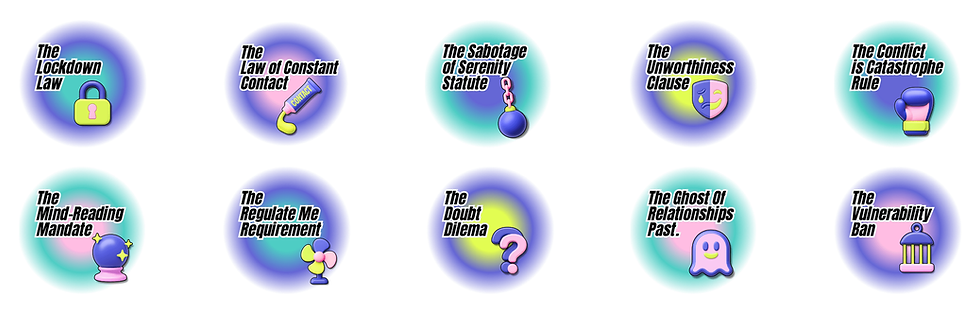
That's why I created a free quiz to help you identify your personal patterns and understand how they impact your relationship dynamics. Once you know the rules you're unconsciously following, you can start to recognize them in real-time and make different choices—ones that build connection instead of destroying it. When you sign up, you'll learn more about relationship sabotage, learn some new relationship skills, and understand attachment styles in a new and refreshing way.

What is Self-Sabotage in Relationships?
Self-sabotage in relationships refers to the self-defeating attitudes and behaviors that undermine our own happiness and relationship stability.
It's when we become both the arsonist and the firefighter—setting fires in our relationship dynamics just so we have something to extinguish.
The Sabotage of Serenity is the ultimate form of relationship sabotage - anxiety convinces you it's a good idea to destroy peace and connection the moment it appears.
When life finally offers you the calm you've been desperately seeking, anxiety rushes in with suspicion, whispering that something must be wrong if you feel happy.
You might pick fights over nothing, manufacture crises, develop sudden trust issues, or create conflict patterns that push your partner away—all because deep down, you don't believe you deserve the happiness you're experiencing.
These self-sabotaging behaviors often show up as picking unnecessary fights, creating relationship dissatisfaction where none existed, excessive jealousy or controlling tendencies, withdrawing emotionally after moments of intimacy, or finding red flags in perfectly healthy situations.
What makes this particularly heartbreaking is that the relationship stability we seek becomes the enemy we feel we have to defeat.
What is the Psychological Reason for Self-Sabotage?
The psychological foundation of self sabotage lies in something profound that psychoanalyst Donald Winnicott observed: "The catastrophe that you fear will happen has already happened."
What he meant is that the doom we attach to the future of our relationship is usually a ghost from our past. We're not really afraid of what's coming—we're afraid of what's already come and left its mark. We import old betrayals, losses, and childhood trauma into the present moment, forcing relationship peace to look menacing.
This is where attachment theory becomes crucial. Your attachment style—developed through childhood experiences with your primary caregivers—creates a blueprint for how you navigate relationship dynamics as an adult. If you developed an insecure attachment style, particularly an anxious or fearful-avoidant attachment style, your nervous system learned that emotional closeness comes with danger.
The psychological mechanism works like this: Your anxious brain isn't just worrying—it's running negative future modeling, acting like an overzealous screenwriter who wants to write a disaster movie when you really want to be in a rom-com.
This creates a cruel twist where distress feels painful but predictable, while peace feels unfamiliar and threatening. When calm moments arise, anxiety doesn't see it as a good thing—it sees it as a problem that needs fixing by restoring the familiar background of worry or conflict and relationship sabotage.
Why Do We Self-Sabotage?
Beyond the psychological theory, there are specific reasons why we engage in relationship sabotage, most rooted in our earliest experiences, emotional triggers, and a lack of relationship skills.
Childhood trauma and insecure attachment are the most common culprits. If your early home was an arena of unpredictability, then quiet moments were never really safe havens. They were just preludes—the silence before the shouting, the calm before doors got slammed, the peace before someone you loved disappeared. Your nervous system learned at a fundamental level that calm equals danger. Peace means you've let your guard down. Serenity means you're not prepared for what's coming.
Fear of abandonment and fear of rejection drive much of this behavior. You spend happy moments today anxiously scanning for proof that there's been a terrible mistake—that you've been given something you don't deserve, and something will surely be taken away. So you end relationships to avoid being abandoned, essentially burning down the house to prevent it from catching fire.
Fear of intimacy and fear of commitment also play significant roles. When someone gets too close, when the relationship feels too good, your self-esteem issues or imposter syndrome kick in. You don't believe you're worthy of this love, so you create distance through conflict or withdrawal. This rejection sensitivity makes you hyper-alert to any sign of partner pursuit pulling back, even when none exists.
Past relationship experiences and emotional abuse create unhealthy dynamics that follow us into new relationships. If you've been hurt before, your brain becomes hypervigilant, seeing threats where none exist and engaging in controlling tendencies or negative self-talk that poison otherwise healthy relationship dynamics.
Think about people who've been incarcerated for a long time. When they finally get out, they often report having a horrible time sleeping because they're not used to the calm. Their nervous system is calibrated to chaos.
The same is true in our relationships—we recreate familiar conflict patterns because we need that noise to feel normal, even if that noise keeps us from being happy or if it causes relationship sabotage.
5 Ways to Recognize Self-Sabotage in Relationships That Matter.
Learning to recognize self-sabotaging behaviors before they impact you is a good start. Here are five key signs:
1. You pick fights after intimate moments. If you consistently find yourself starting arguments right after sex, deep conversations, or moments of genuine connection, this is a classic sign of the Sabotage of Serenity. Your fear of intimacy is creating conflict to restore emotional distance.
2. You manufacture problems when things are going well. When your relationship is stable and happy, you suddenly become suspicious, start looking for red flags that don't exist, or bring up issues from weeks or months ago. This self-defeating attitude stems from the belief that "this is too good to be true" and something bad must be coming.
3. You struggle with "relationship anxiety or gut feeling" confusion. You can't distinguish between legitimate concerns and anxiety-driven fears. Every small thing your partner does gets interpreted as a sign of relationship dissolution rather than normal human behavior. This rejection sensitivity keeps you in a constant state of hypervigilance.
4. You engage in push-pull dynamics. You pursue your partner when they pull away, but withdraw when they come closer—a pattern often seen in fearful-avoidant attachment styles. These unhealthy dynamics include contempt, stonewalling, and other destructive conflict patterns that create relationship dissatisfaction for both partners.
5. You experience physical discomfort during peaceful moments. This is crucial—if you feel genuinely anxious, restless, or uncomfortable when things are calm and loving, your nervous system is signaling that peace feels dangerous. You might notice your heart racing, feeling the urge to "do something," or experiencing intrusive negative self-talk during happy moments.
How Do I Stop Self-Sabotaging My Relationship?
Breaking free from self-sabotaging behaviors requires patience, self-awareness, and often professional support. Here are evidence-based relationship skills to help you stop relationship sabotage:
Recognize the pattern and pause.
The work always begins with recognition. When you feel that familiar urge to pick a fight or create distance, pause and name it. Ask yourself: "Is this about my partner, or is this about my fear of abandonment? Is this relationship anxiety or gut feeling?" This moment of awareness is where change begins. For those ruled by insecure attachment, peace is genuinely uncomfortable—it feels vulnerable and dangerous. Acknowledging this is a crucial inner work.
Build your tolerance for peace.
The longer you can tolerate that urge to create chaos and resist actually acting on it, the better, if it's a minute at first, if it's 30 seconds at first—fantastic! You are already changing relationship dynamics. The goal is to sit with discomfort for longer and longer. It will fade. This is about training your nervous system that calm doesn't equal danger, addressing the childhood experiences that taught you otherwise.
Communicate using "the story I'm making up."
Instead of coming from a fear-based, accusatory stance driven by trust issues, try: "I'm making up this story that you're mad at me" or "I'm making up this story that something's wrong." This relationship skill transforms accusations into invitations to collaborate. It acknowledges your emotional triggers while giving your partner space to respond without defensiveness, which helps prevent contempt and stonewalling.
Seek relationship therapy or professional support.
Self-reflection is important, but it takes practice, and that's where relationship therapy becomes invaluable. A therapist can help you understand your important aspects of you attachment style, work through childhood trauma, address self-esteem issues, and develop healthier relationship skills. Many therapy platforms now offer specialized support for relationship anxiety and attachment-related issues. Working with a professional provides the mirror you need to see relationship sabotage patterns you might not recognize on your own.
Be patient with your nervous system.
Remember that your brain learned these self-sabotaging behaviors over years, maybe decades, as protective responses to past relationship experiences or childhood experiences. It won't unlearn them overnight. Be compassionate with yourself as you do this inner work. You're not broken—you're rewiring deeply ingrained patterns that once kept you safe but now prevent you from receiving the love you deserve.
Address underlying fears directly.
Work on your fear of rejection, fear of intimacy, self-defeating attitudes, fear of abandonment, and fear of intimacy through therapy, journaling, or other professional support. Understanding that perfectionistic traits and imposter syndrome often fuel these fears can help you develop more realistic expectations of yourself and your relationships.
The Sabotage of Serenity doesn't have to rule your relationships forever. With awareness of your attachment style, development of better relationship skills, and willingness to recognize self-sabotaging behaviors when they arise, you can learn to sit with peace instead of destroying it. You can allow yourself to be happy without waiting for the other shoe to drop.
Your relationship can become the refuge it's meant to be—not a battlefield you create to feel safe.
Therapy For Relationship Anxiety and Fear Of Intimacy?
Oliver Drakeford is a licensed marriage and family therapist who helps people overcome relationship anxiety to build great relationships. For more resources on identifying and breaking the rules of relationship anxiety, visit his website or follow him for more content on building healthier relationships.


The point about calm feeling dangerous after unpredictable childhoods really lands, because it explains why reassurance alone often does not work. I also think it is worth being careful about what gets mixed into conversations like this; seeing something like https://color-games.com/, https://fortune-king-jackpot.com/ alongside a serious mental health topic can pull attention away from the actual issue. The practical suggestion to name “the story I’m making up” is definately one of the more useful takeaways here. It gives people a way to slow down without immediately accusing their partner or pretending the anxiety is not there.
From tinder phone number I utilized customer service for assistance with a technical issue, and I was pleasantly surprised by the promptness and professionalism of their support team. The representatives were knowledgeable and addressed my concerns with clarity, ensuring that I felt valued as a user. The overall experience was efficient, and I appreciated the follow-up communication to confirm that my issue had been resolved. This level of customer service enhances the overall appeal of the platform, making it a reliable choice for dating and social networking.
I've been running some performance audits on how modern web applications manage heavy canvas layer compositing without bloating mobile load times. While checking out the asset initialization and network requests on https://7bitcasino.com/games/booming/booming-seven-deluxe-legacy, I noticed how cleanly the browser script bundle handles the high-contrast red seven and golden bar assets. The rendering pipeline loads these vibrant neon layout elements flawlessly without causing any layout shifts on mid-range devices. Does anyone know if they are utilizing a custom WebGL texture-packing framework to keep the retro graphic blocks this lightweight?
Hi everyone! I personally took some time to explore the website after coming across a mention of playjonny casino in a gaming discussion. With practically grouped game sections, the design was quite clear. Transitioning between the slots and live tables was smooth, and I found the loading stable. Clear and understandable was how I would describe the explanation of the promotional terms. Because the basic account functions worked exactly as expected, it added to the overall feeling of reliability. For casual play, the impression I got was suitable, neutral, and calm.